Battery Corporal
Willis S. Cole
Military Museum
A Non-Profit Corporation, Washington U.S.A.

B-17G-35VE
Serial Number: 42-97904
2nd Lt. Donald J. Gott
Congressional Medal Of Honor
Killed In Action near
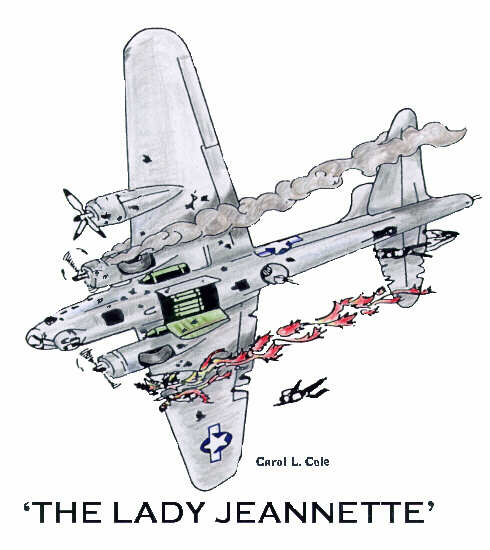
Hattonville, France, on 9 November, 1944, aboard the B-17G-35VE,
Sn: 42-97904, named: 'The Lady Jeannette.' Lt. Gott was the pilot
aboard the bomber assigned to the
729th Bombardment Squadron (H), 452nd Bombardment Group (H), 45th
Combat Wing, 3rd Air Division,
8th United States Army Air Force, Station 142, Deopham Green, England.
GOTT, DONALD J. (Air Mission)
Rank and organization: First Lieutenant, U.S. Army Air Corps,
729th Bomber Squadron,
452nd Bombardment Group. Place and date: Saarbrucken,
Germany, 9 November 1944.
Entered service at: Arnett Okla. Born:
3 June 1923, Arnett, Okla. G.O. No.: 38, 16 May 1945.
Citation: On a bombing run upon the marshaling yards at
Saarbrucken a B-17 aircraft piloted by
1st Lt. Gott was seriously damaged by antiaircraft fire. Three of the
aircraft's engines were damaged
beyond control and on fire; dangerous flames from the No. 4 engine were leaping back as
far as the
tail assembly. Flares in the cockpit were ignited and a fire raged within, which was
further increased
by free-flowing fluid from damaged hydraulic lines. The interphone system was rendered
useless. In
addition to these serious mechanical difficulties the engineer was wounded in the leg and
the radio
operator's arm was severed below the elbow. Suffering from intense pain, despite the
application of
a tourniquet, the radio operator fell unconscious. Faced with the imminent explosion of
his aircraft,
and the death of his entire crew, mere seconds before bombs away on the target, 1st
Lt. Gott and his
copilot conferred. Something had to be dome immediately to save the life of the wounded
radio
operator. The lack of a static line and the thought of his unconscious body striking the
ground in
unknown territory would not bring immediate medical attention forced a quick decision. 1st
Lt. Gott
and his copilot decided to fly the flaming aircraft to friendly territory and then attempt
to crash land.
Bombs were released on target and the crippled aircraft proceeded alone to
Allied-controlled territory.
When that had been reached, 1st Lt. Gott had the copilot personally inform all
crewmembers to bail
out. The copilot chose to remain with 1st Lt. Gott in order to assist in
landing the bomber. With only
one normally functioning engine, and with the danger of explosion much greater, the
aircraft banked
into an open field, and when it was at an altitude of 100 feet it exploded, crashed,
exploded again and
then disintegrated. All 3 crewmembers were instantly killed. 1st Lt. Gott's
loyalty to his crew, his
determination to accomplish the task set forth to him, and his deed of knowingly
performing what
may have been his last service to his country was an example of valor at its highest.
lease Note: Beginning with the sentence, With only
one normally operating
engine, and with the danger of explosion much greater the aircraft banked...
Over 600 hours research at the crash site and interviewing
living eyewitnesses
have proven from the "danger of explosion onward, the description of the
crash of this bomber is not true.
In fact, it is an exact description the crash of a "Top
Secret B-24," Sn: 42-51226,
while flying a "Top Secret Night Missions" with the 100th Group RAF over
France early on the morning of 10 November, 1944, when its Number Three
Engine was struck by FLAK, and due to a loss of electrical output the bomber
later crashed about 2:30 am, 1,000 feet north of the town of TINCOURT-
BOUCLY, Department of the Somme. Some 14 hours later and about
150 miles
from the actual crash of Lt. Gott's aircraft.
The "Top Secret" B-24J bomber belonged to the 36th
Bombardment Squadron
(RCM - or Radar Counter Measures), which was attached to the 100th Group,
RAF. The Squadron's aircraft flew "Top Secret Electronic Radar Jamming
Missions at night to protect the RAF Bombers over Europe. The work of
these aircraft was so "Top Secret" that only the record of the death of three
finally lead us to the record of the aircraft loss, that in the end, proved the
identification of the bomber that crashed at TINCOURT-BOUCLY, as well
as the truth of the identity of the human remains contained in the Grave at
Cartigny, the location which began this research on Christmas Eve, 1991.
The true location of the crash of Lt. Metzger's aircraft,
the B-17, the Lady
Jeannette is in the Bois de HATTONVILLE, located 3.2 km east of the
Village of HATTONVILLE, Department of the Somme. Which is
located about 25 miles south-east of Verdun in eastern France and about
5 miles from the American St-Mihiel World War One Cemetery.
Regardless what is written in the Medal Citations, when
compared to
the real crash of the B-17, it does not detract from what Lt. Gott and
Lt. Metzger were awarded the Medals for. In fact, the last two minutes
of their flight is as heroic as their actions over Germany.
When the bomber began its last turn, it was over a very
large forest
which stretched several km in each direction. Their final turn was
an attempt to turn back to a large field, but 800 feet before that
field, the bomber began a very controlled settling into the large
forest.
At this point, it is most important for the reader to know,
the
bomber had turned over the Village of Hattonville, where the
563rd SAW BN HQ CO was located. The 563rd Signals Aircraft
Warning Battalion Headquarters and Headquarters were in the
Village of HATTONVILLE from the 14th of September, 1944, to
the 2nd of December, 1944.
The bomber was under 475 feet when it turned over the
village. As
it approached the Villagers and the Americans began running in
many directions as they all thought the bomber might crash into
the village. Once the turn was completed, the bomber was heading
back along the exact same track it had came from, only this time
it was about 600 feet further north on its way back toward Germany!
The first to die, was Sgt. Herman B. Krimminger, the Tail
Gunner
who was hanging under the tail of the bomber. Evidence of his
death was discovered 320 feet from where the first large pieces
of the bomber came to rest. His torn-apart remains were reported
as being seen by the Bombardier. 2nd Lt. Joseph Harms, the only
surviving crewman who actually went to the crash site, before
being taken to the 109th Evacuation Hospital.
Three of the four other survivors were also taken the
109th,
TSgt. Russell Gustafson, Flight Engineer; SSgt. Joseph Fross,
Ball Turret Gunner; and 2nd Lt. John Harland, Navigator.
SSgt. William Roberts, the Waist Gunner, was the only one
of the 5 survivors who were not taken to the 109th. He was picked
up a jeep which had driven across a field to the edge of the woods
where he had landed and in less than an hour, he was at the
Etain Air Base, where the 425th Night Fighter, of the XIX TAC
was headquartered. After being checked at their hospital unit,
SSgt. was put aboard a small plane by 5:00 pm he was walking
around downtown Pairs, still in his flight clothes that were bloody
from the wounded Radio Operator, TSgt. Robert Dunlap, who he
had helped, after Dunlap had been wounded over Germany by
one of the two FLAK bursts that, in the end, caused the crash of
the Lady Jeannette.
The first large piece of the bomber to strike the earth,
was the
right wing. About 300 feet into the woods, the bomber struck
two large trees, tearing off both wings at the wing roots. The
right wing hit on the ground first, with the broken metal
mounts of the Number Four Engine that had been shot off
over German digging deeply into the ground. As the wing
hit the ground, the Number Three Engine, the only one still
able to run at full emergency power, tore off and rolled over
100 meters back through the woods to the west.
The left wing broke loose, when it did the Number One
Engine,
the engine that was stopped by the 2nd FLAK burst, broke
free, traveled about 50 feet and buried itself in the earth. The
rest of the wing traveled about 100 feet in all, before it came
to rest, leaning against a tree. Its wheel assembly broke free
and came to rest 15 feet away and the super hot Number Two
Engine broke free, came to rest 20 feet away and burned hot
enough to melt aluminum pieces on the engine.
As the wings broke loose, the tail also broke loose taking
the
rear Radio Compartment door with it. The tail fell to the
earth within feet of the right wing, creating a large impression
in the deep, damp clay of the woods floor.
Still at a height, perhaps of 30 feet, the broken forward fuselage,
now looking a bit like a silver cigar continued forward. However,
now it was wobbling and with no rear Radio Room Door, the Radio
TSgt. Robert Dunlap, who had been lying on the floor, wounded
and unconscious, and by now, perhaps already dead, fell out of the
bomber's Radio Compartment onto the soft duff of the forest floor.
The broken forward Fuselage continued in the air for
another 126
feet before the Nose Turret Guns began to dig two trenches in the
forest floor and the nose began to push dirt ahead of it, like a
bull dozer.
Twenty-seven feet from where the Nose Turret Guns first
began to
dig their trenches, there was enough earth in front of the bomber
to divert its forward momentum to the right into an 85 degree
turn, where it came to a stop with the broken off rear section
over the point where the turn began.
The distance from the first evidence of the bomber settling
into
the woods to the point where the tip of the nose came to rest is
around 600 feet. Obviously, it did not explode in mid-air and
it has been proven, it did not explode and disintegrate as stated
in the Citations, nor did the last three aircrew in the bomber die
as stated.
Thus, the NEXT TO THE "Last Flight Of The
Lady Jeannette"
came to an end. Greatly different, than the description in the
Two Congressional Medal Of Honor Citations.
Within 5 minutes the first two Frenchmen arrived at the
crash
site. The flash fire that had started as the broken bomber had
came to rest was already over. Only the engine and tire was still
burning brightly, along with some other smaller items around
the crash site.
The first Frenchman crawled up into the broken end of the
forward fuselage to see if he could help the pilots. He found
both, sitting dead and slumped over in their seats. As he got
back out of the bomber, his friend called him over to a body
lying in the blackberry brambles which infected the crash
site area. They thought this man had bailed out so late, that
he had landed in the flash fire and died. They had no way of
knowing at that time, he was the Radio Operator who had
fallen out of the broken bomber, while it was still in the air.
Within 45 minutes, several surviving French Eyewitnesses
state
they saw Americans from the unit in their Village at the crash
site, standing next to the three bodies that had been carried to
edge of the crash site zone in the woods. At that time, the French
were forced to leave and they were kept away for two or three
more days. However, every living eyewitness and every family
legend has one strong point, there were three dead men at the
crash site, that were seen by the French who went to the crash
site. All of them state, there were three bodies, not little pieces
of disintegrated bodies, but basically whole bodies.
Just to be certain, you the reader understand, what you
have
just read is the true end of this flight and the Citations are
wrong. However, in no way is the above or any of the research
we have ever conducted attempted to make any less of the
heroism of the Pilots in question. As we believe, when the true
story of their last two minutes of life is fully known and understood,
their heroism is greatly enhanced and needs to be known.
Go To The 'Lady Jeannette' Home Page:
Go To The Bomber
Return To The Museum's Front Page's Page:
C.M.H.Return To The Museum's Front Page: WW1.ORG
This Page Last Updated On: Sunday, May 15, 2005 20:25